
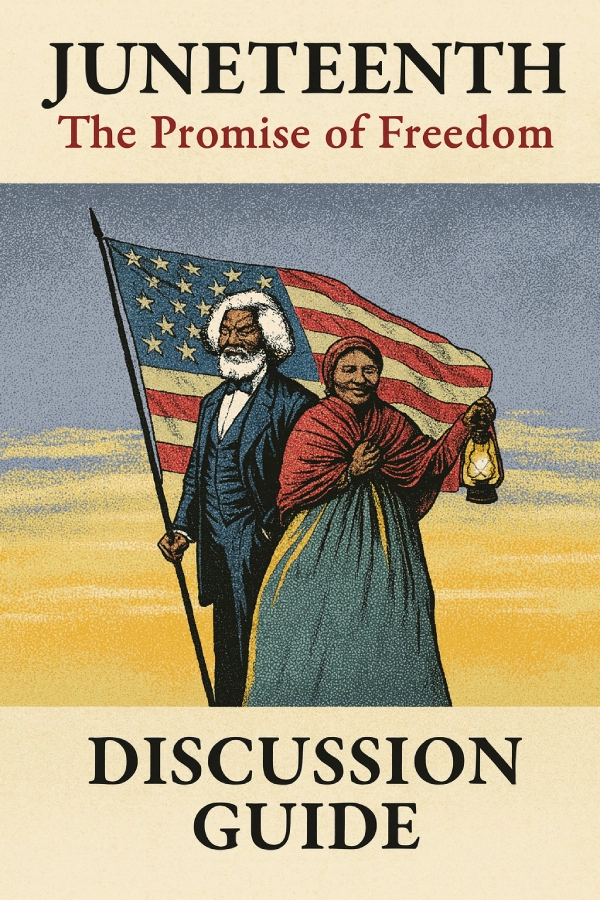
Juneteenth:
Discussion Guide
Turn history into healing and conversation into action.
Welcome to all of you who bought my book, Juneteenth: The Promise of Freedom. I’ve written a discussion guide to help you get the most out of my book. This guide was created for educators, faith leaders, book clubs, and community organizers to host meaningful dialogues about the history, legacy, and promises of Juneteenth and Black history. Grounded in the book’s 22 well- researched chapters, the Guide takes participants deeply into the true story of Black history and challenges the Eurocentric version we’ve all been taught.
What’s Inside
- Chapter-by-chapter discussion questions that move from Africa’s origins to majestic empires, to enslavement, Reconstruction, Jim Crow, and the modern Juneteenth movement.
- Overarching questions to connect themes across the whole book.
- A range of question types to help you probe, discover, connect, reflect, and act.
- Facilitation tips for safe, courageous, and necessary conversations.
- Sample agenda and Meeting Options to help you plan your discussion sessions and know which chapters to discuss.
How to Use This Guide
- Read: Have your group read the book Juneteenth: The Promise of Freedom by Dr. Charles Taylor.
- Discuss: Then discuss the book chapter by chapter or bundle them into themed sessions. Use the Guide’s questions to prompt deeper reflection.
- Connect: Invite personal stories and community memory; make space for multiple truths in your discussions.
- Act: Close every discussion session with a next step that requires some form of action: civic engagement, learning goals, or community service.
Goals for Participants
- Understand the historical journey from Africa to Juneteenth and discuss what a common ancestry means to world history.
- Explore how laws, culture, and policy carry the legacy of past injustices into the present.
- Reflect on what freedom really means and what remains unfulfilled.
- Commit to practical steps that advance equity, dignity, and belonging.
- Discuss how knowing the truth about Black history can help heal the nation.
Who This Guide Serves
- Teachers & students • Book clubs • Faith & civic groups
- DEI teams & nonprofits • Families & intergenerational circles
- Anyone interested in the truth about Black history.
Ready to Lead a Crucial Conversation?
Download the Discussion Guide and host your first session this month. Invite a few friends, a class, or your whole organization, then let the questions in this Guide do their work.
Price: The guide is only $24.95, and you can make up to 25 FREE copies for your organization. Your whole team can have their own copy at no cost. ORDER NOW and download the PDF file.
Start the Conversation. Share the History. Build the Future.
SAMPLE DISCUSSION QUESTIONS FROM THE GUIDE
You’ll find over 200 thought-provoking questions in this Guide, covering nearly every aspect of Black History. Here is a small sample of the hundreds of insightful questions you’ll find. Each question pushes us to look deeper, challenging myths, filling in erased histories, and facing painful truths. By engaging with them, your group can move beyond surface knowledge to grapple with the roots of racism, the resilience of African peoples, and the ongoing need for truth-telling and repair. These questions are not intended to provide easy answers, but to invite conversations that can reshape our understanding of history and ourselves. They provide a framework for thoughtful, evidence-based dialogue.
- What did you learn in this chapter that challenged what you were taught about where human history “began”? What surprised or unsettled you and why?
- Why do you think the story of ancient African migration and exploration is omitted in most history books? How does that omission support the myth of White superiority?
- The chapter stresses that race is a social construct, not a biological reality. How does holding that truth help us address racism without erasing people’s lived experiences of discrimination?
- The chapter highlights that Africans were the first Homo sapiens and built some of the earliest kingdoms and empires. How does this reshape common understandings of where human civilization began?
- The chapter details rape and slave-breeding. How do we center Black women’s voices in truth-telling and repair, and what forms of redress feel appropriate?
- The Three-Fifths Clause inflated Southern power by counting people who had no vote. Where do you see modern echoes of bodies being counted while voices are silenced, and how can we address this issue?
- With at least 47 people fleeing George Washington’s Mount Vernon and many more across the South, what do these escapes reveal about the “happy slave” myth?
- If Black troops were, as Lincoln said, essential to Union victory, why did Reconstruction give way to Jim Crow? Trace wartime politics to postwar backlash.
- Why were the enslaved Blacks in Texas the last to learn that they were free?
- Which emotions and decisions, such as staying, leaving, searching for family, or seeking work, most influenced the first days after freedom in Galveston, and why?
- Was land redistribution (“forty acres and a mule”) the indispensable missing ingredient of freedom? Explain based on information from the chapter.
- How did the Lost Cause narrative reshape public memory after the Civil War, and what concrete policies or practices did that myth help justify?
- Plessy v. Ferguson made the “separate but equal” doctrine constitutional. What everyday freedoms did that doctrine most effectively restrict, and why?
- The text highlights interracial cooperation (abolitionists, Underground Railroad, modern allies). What distinguishes effective allyship from performative gestures today, and how should accountability be built in?
- How does understanding “whiteness” as a political tool change conversations about power, privilege, and belonging in your circles?
…….AND HUNDREDS MORE OF GREAT PROBING QUESTIONS